Money and markets are powerful tools in developing our world, most would agree. But many have experienced negative effects in their application; including environmental degradation, unequal distribution and crowded, unhealthy cities. To achieve a sustainable future, and the Sustainable Development Goals in particular, we must consider all options. Should we abandon industrial capitalism and our present monetary system altogether or should we introduce some form of sustainable five-year planning regime? At the other end of the spectrum there is the idea to harness and utilize the power of money and markets to meet the challenge and to achieve our important goals.
The Swedish Sustainable Economy Foundation has shown that there is a reliable and practical way to improve the economic system and “to make it beneficial to do the right thing” in order to solve both local and global issues in an efficient and beneficial way. In other words, properly applied, the power of markets and the use of money (i e, economic signals) as a tool can support and guide humanity towards a peaceful, sustainable and prosperous future.
See the economy as a system
The economic system is just that – a system – and systems can be designed and utilized to perform to certain requirements. An economic system with the necessary control points and sufficient stabilizing feedback can serve humanity by ensuring that the better challenges are solved, the better it (economically) rewards everyone in the system. In other words, the Foundation is proposing a system upgrade, where it pays, the actors/people in the economic system, to act responsibly, fairly and sustainably.
System requirements: supporting human values
The model requires the economic system to be aligned with, and to serve and support human values and needs and at the same time to care for the biosphere. Fortunately, advances in engineering and digital systems to control performance, allow this next leap to happen. Breakthrough developments in Market-Based Instruments relying on relevant information and giving feedback to citizens, like Climate Dividends, provide the platform for a new approach to benign financial and economic governance.
Apply system stabilisation
To understand the potential for a transformation of the financial system it is necessary to understand recent advances in engineering of system control. With the advent of digital technology, engineering has developed a way of applying a control layer to a device to ensure that it behaves according to intentions and specifications. Examples include the anti-locking devices fitted to brakes, cruise controls and the automatic landing systems in aircrafts. This is called control engineering.
Control engineering adds a control layer to a device through which the operator sets the performance of the device. The functions of the device are controlled in turn by actuators. These actuators are connected via the control layer to sensors. Control is achieved by the digital control layer receiving feedback from the sensors, input from the operator and through a set of rules, which, at a sufficiently high rate, control the actuators.
The possibility for an economy that serves all is there
The benefit of the control engineering approach is that the controls can be simplified, yet the control will be more precise and the workings of the device can be highly sophisticated.
In a financial system, subsidies and surcharges on existing levies and/or taxes could act as actuators. The diagram below shows a simplified view of the financial system’s four main types of actors: citizens, firms (including banks), national government and local authorities.
Important to grasp from this diagram is the difference between private and public accounts. Only citizens hold private accounts, this includes ownership in firms and as tax-payers, influence over governing bodies. There are no citizens involved in the other three types of actors that are not also part of the citizens’ group. This means that the rules governing the system should be put in place to ultimately benefit citizens.
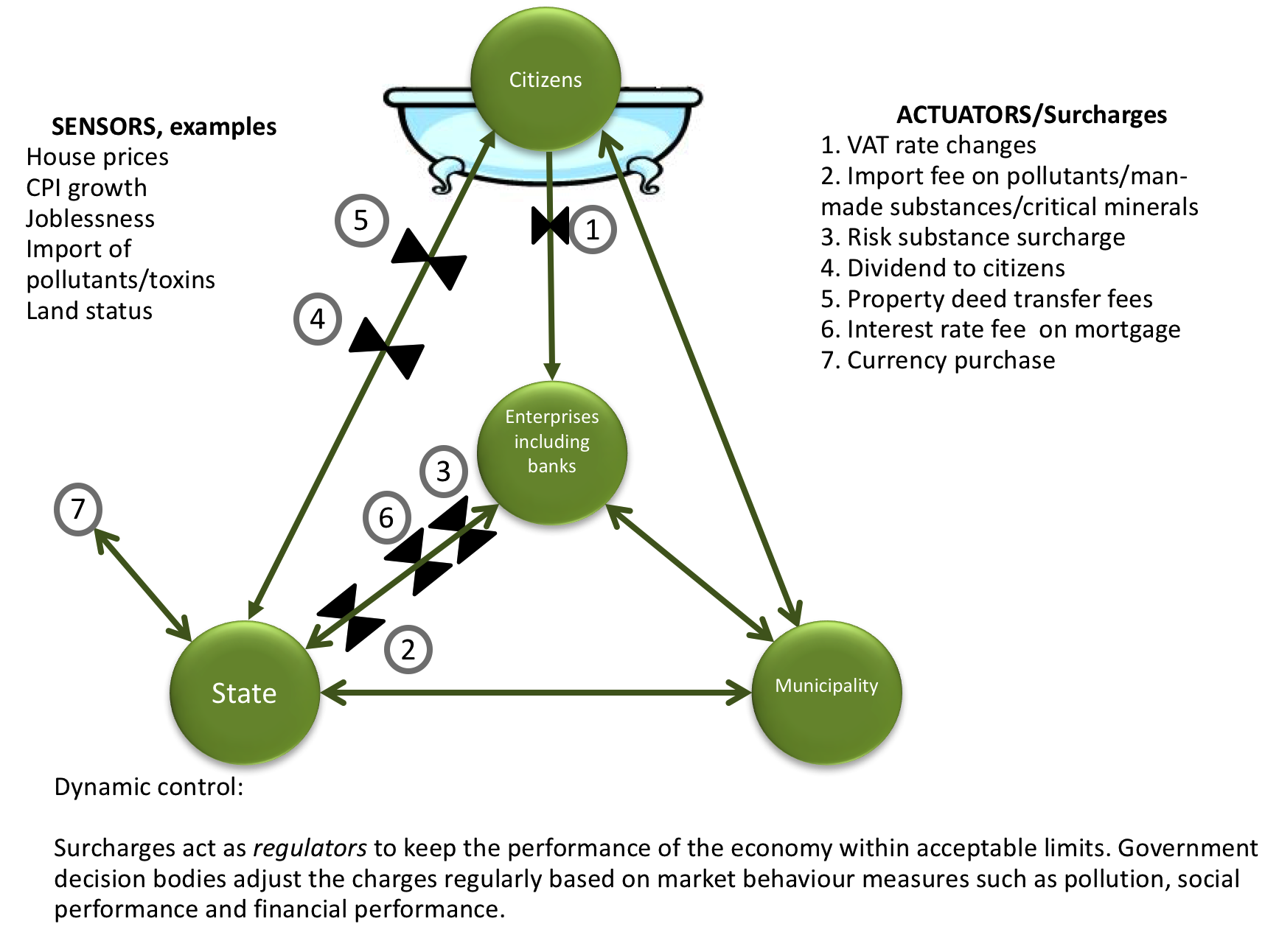
Money flows from citizens to the other actors in the form of purchases, fees, taxes, etc. Money also flows between the other actors in the same way. For the system to work, the other three types of actors need to pay money back to citizens in the form of wages, subsidies, grants, etc.
It is in this model that points can be identified where adjusting the incentives could radically change the purchasing and production behavior.
Add surcharges and negative charges to existing fees and taxes
Most tax and fee systems are rather complex. Adding more would only add to the complexity. The model proposes levying surcharges on already existing instruments to simplify administration. These surcharges (which also can be negative) can be levied on, for example, VAT, import fees, interest rates, employers’ tax and property deed transfers. For example, levying a surcharge on the import of fossil fuels would make fossil fuels and products dependent on fossil fuels more expensive and encourage the purchase of alternatives. If at the same time the revenues from the fees levied were to be paid back to citizens, then the purchasing power – and thereby overall demand in the economy – can be retained, this will act as a kind of actuator.
A true polluter pays solution
Step by step it could work like this for pollutants: a fee is levied on substances that pollute as they enter the economy. The fee is adjusted depending on how the market responds in reducing pollution. If targets are not met, the fee is increased. If they are above target, the fee is reduced.
An essential feature of stabilizing mechanisms is feedback. A sufficient proportion of the fees levied should be channeled back to taxpayers as a dividend. The increased costs of production inputs due to the fees are merely passed on to consumers. This could, potentially, have a negative influence on the total demand and could be negative for an economy, so feeding back the revenues from the fees as dividends to maintain the buying power and the circulation of money is essential for a robust and healthy economy.
So, the slower the market responds to pollution surcharges, the higher the fee, and the bigger the revenue and the more economically beneficial distribution of the dividend to the people (i e, the consumers) making it possible to afford and to purchase the non-polluting and more sustainable environmentally friendly alternatives on the market.
In this transparent and efficient way, the power of the market can be harnessed to create a reliable and sufficient, true demand for non-polluting products and services.
Dear sirs, I am a journalist with the Canadian newspaper https://www.theglobeandmail.com/. We are writing a piece on carbon markets and would like a statement from one of your experts. Please do send us an email with your comments. The article is below.
Can carbon trading on the options market be effective in reducing a society’s carbon emissions. The Swedish Sustainable Economy Foundation believes so. In a study carried out by the Nordic Council of ministers, they proposed that raising a levy on carbon imported into the country, or extracted, would encourage firms to find less polluting alternatives.
The Canadian Carbon Tax Scheme
Since the publication of this work, Canada has implemented a carbon pricing system to reduce greenhouse gas emissions and combat climate change. The system includes a carbon tax that applies to fossil fuels such as gasoline, diesel, and natural gas, as well as a cap-and-trade system in certain provinces.
The carbon tax works by charging a fee per tonne of carbon dioxide (CO2) emissions. The fee started at $20 per tonne in 2019 and increased to $40 per tonne in 2021. The price will continue to increase to $50 per tonne in 2022 and beyond.
The revenue collected from the carbon tax is returned to Canadians through a variety of mechanisms, including the Climate Action Incentive, which is a rebate paid to households in provinces that do not have a carbon pricing system that meets federal standards. The amount of the rebate varies based on the number of people in the household and the province of residence.
In addition to the Climate Action Incentive, the government also invests the revenue from the carbon tax into programs and initiatives that reduce greenhouse gas emissions and support a cleaner economy. For example, the government has invested in public transit, energy-efficient buildings, and renewable energy projects.
Canada’s federal carbon tax was first implemented in 2019 and has been increasing each year. The initial price was set at $20 per tonne of carbon dioxide (CO2) emissions, and it has increased by $10 per tonne each year. The carbon tax increased to $30 per tonne on April 1, 2020, and then to $40 per tonne on April 1, 2021.
The current plan is to continue raising the carbon tax by $10 per tonne per year until it reaches $50 per tonne in 2022. After that, the government has not yet announced any specific plans for further increases or changes to the carbon tax.
However, it is worth noting that some provinces in Canada have their own carbon pricing systems or have opted out of the federal carbon pricing system, and the specifics of those systems may differ from the federal system. Some provinces have also implemented their own plans to reduce greenhouse gas emissions, which may include a carbon tax or other measures.
Overall, Canada’s carbon pricing system is designed to provide a financial incentive for individuals and companies to reduce their greenhouse gas emissions, while also returning the revenue collected to Canadians through rebates and investment in emission reduction initiatives.
An emerging options market
The Swedish Foundation believed that the emergence of a carbon tax would give rise to options trading. Here is how such a market might work:
Options trading on the expected increase of a Canadian province’s carbon tax is a form of derivative trading where investors can make a bet on whether the carbon tax will increase or decrease in the coming year. Here are some steps to set up an options trading scheme on the expected increase of a Canadian province’s carbon tax:
Choose an options market: The first step is to select an options market that offers options on carbon taxes. The Chicago Board Options Exchange (CBOE) and the International Securities Exchange (ISE) are popular options markets that provide carbon tax options.
Determine the underlying asset: The underlying asset for the option contracts should be the carbon tax policy of the chosen Canadian province. For example, if you want to speculate on the expected increase of the carbon tax in British Columbia, then the underlying asset would be the British Columbia carbon tax policy.
Choose the option contract: There are two types of option contracts: call options and put options. Call options give the holder the right to buy the underlying asset at a specific price, while put options give the holder the right to sell the underlying asset at a specific price. Choose the type of option contract that best suits your strategy.
Determine the strike price: The strike price is the price at which the option contract can be exercised. Choose a strike price that reflects your forecasted increase in the province’s carbon tax for the coming year.
Determine the expiration date: The expiration date is the date by which the option contract must be exercised. Choose an expiration date that is far enough into the future to allow for possible changes in the province’s carbon tax policy.
Place the trade: Once investors have chosen the option contract, strike price, and expiration date, they can place your trade on the options market. They buy or sell their option contract at the market price, depending on their strategy.
Manage the position: As the expiration date approaches, they monitor the province’s carbon tax policy closely. If the province increases its carbon tax in their favor, they may choose to exercise their option contract to realize a profit. If not, they may choose to let the option contract expire.
An example of options trading
Here is a concrete example: Assume that it’s currently January 1, 2023, and the BC government has announced that it will raise its carbon tax rate by 10% during the coming year, from CAD 40 to CAD 44 per tonne of CO2 emissions. You believe that there’s a 75% chance that the BC government will follow through on this announcement, but you’re not entirely sure. To hedge your exposure to this uncertainty, you decide to enter into an options trade.
You purchase a call option with a strike price of CAD 42 per tonne of CO2 emissions, which gives you the right to buy carbon tax credits at the strike price if the BC government raises the carbon tax rate above CAD 42 per tonne by the expiration date of the option. You pay a premium of CAD 1 per tonne of CO2 emissions for this option, which covers the cost of the option contract.
If the BC government does raise the carbon tax rate to CAD 44 per tonne of CO2 emissions, your call option will be in-the-money, meaning that you can exercise your right to buy carbon tax credits at the lower strike price of CAD 42 per tonne. You can then sell these credits on the open market for a profit, since their market value will likely be higher than the strike price. Your profit will be the difference between the market value of the carbon tax credits and the strike price, minus the premium you paid for the option.
On the other hand, if the BC government does not raise the carbon tax rate above CAD 42 per tonne, your call option will expire worthless, and you’ll lose the premium you paid for the option. However, since you’re hedging your exposure to uncertainty, this loss will be offset by the reduced risk of a potential loss due to the carbon tax rate not being raised.
As an example, let’s assume that the market value of carbon tax credits is CAD 48 per tonne of CO2 emissions at the expiration date of the option, and that you purchased 1000 tonnes of CO2 emissions worth of options. Here’s how your profit or loss would be calculated, based on different scenarios:
If the BC government raises the carbon tax rate to CAD 44 per tonne:
You can exercise your call option and buy 1000 tonnes of CO2 emissions worth of carbon tax credits at the lower strike price of CAD 42 per tonne.
You can then sell these credits on the open market for CAD 48 per tonne, for a total of CAD 48,000.
Your profit will be CAD 48,000 – (CAD 42,000 + CAD 1,000 premium) = CAD 5,000.
If the BC government does not raise the carbon tax rate above CAD 42 per tonne:
Your call option will expire worthless, and you’ll lose the CAD 1,000 premium you paid for the option.
If the BC government raises the carbon tax rate, but not to CAD 44 per tonne:
Your call option will expire worthless, and you’ll lose the CAD 1,000 premium you paid for the option. However, this loss will be offset by the savings you’ll receive from paying a lower carbon tax rate than you would have if the rate had been raised to CAD 44 per tonne without the option hedge.
Benefits to Canada of speculation in options
One of the main benefits of options trading on carbon tax rate increases is that it creates a financial incentive for companies and individuals to reduce their carbon emissions. By allowing investors to hedge against potential losses resulting from price increases, options trading makes it possible for companies and individuals to take a longer-term view of their carbon emissions and invest in reducing them. For example, a company that is heavily dependent on fossil fuels for its operations may purchase options on the BC carbon tax rate in order to hedge against the risk of rising carbon prices. In doing so, the company creates a financial incentive for itself to invest in energy efficiency measures or to switch to cleaner sources of energy.
Another benefit of options trading on carbon tax rate increases is that it can help to create a more efficient carbon market. The market for carbon credits is relatively new and still developing, and there is often a lack of liquidity and transparency in the market. By allowing investors to speculate on the future direction of carbon prices, options trading can help to bring more liquidity and transparency to the market, which can in turn help to reduce the cost of carbon credits and make it easier for companies and individuals to comply with carbon pricing regulations.
The limitations of trading in carbon tax options
Macro economists present several arguments on the limitations of creating an options market that speculates on how much the British Columbian government will raise its carbon tax, with the underlying asset being the carbon tax. While it is true that carbon pricing has been recognized as an effective tool to incentivize individuals and firms to reduce their carbon emissions, the creation of an options market that speculates on the carbon tax rates may not lead to a significant reduction in emissions.
The main reason why options trading on carbon taxes may not lead to a reduction in emissions is that it does not address the fundamental issue of carbon externalities. Carbon externalities refer to the costs that carbon emissions impose on the environment and society, which are not reflected in the market price of fossil fuels. The failure to internalize these costs means that individuals and firms are not incentivized to reduce their carbon emissions to the socially optimal level. Therefore, options trading on carbon taxes is unlikely to have a significant impact on carbon emissions, as it does not address the root cause of the problem.
Furthermore, the effectiveness of options trading on carbon taxes as a policy tool to reduce emissions depends on a number of assumptions, such as the efficiency of the market and the ability of individuals and firms to respond to price signals. In practice, the market for carbon credits is still developing and there is a lack of transparency and liquidity in the market. Additionally, firms may not be able to respond to price signals in the short run due to sunk costs and other market imperfections. As a result, options trading on carbon taxes may not lead to the desired reduction in emissions, as it assumes a perfect market that may not exist in reality.
Another limitation of options trading on carbon taxes is that it may result in price volatility, which could be detrimental to both the economy and the environment. Carbon prices are subject to significant fluctuations due to changes in government policies, economic conditions, and other factors. The creation of an options market that speculates on carbon tax rates may exacerbate this volatility, as it could result in speculative behavior and market manipulation. The resulting price volatility could have a negative impact on the economy and the environment, as it could discourage investment in clean technologies and renewable energy sources.
Hi Anders. No comments. You can see all comments as a visitor to the site.
Hi Anders. As you can see there have been no comments. You can see all comments as a visitor to the site.
Hello Stephen,
Has there been any comments on this subject?
Please respond,
Anders